Cohort 6 Projects
EmpowerHER: Bridging Health Disparities in Breast Cancer Care for Latinas
Team: Amaya Tucker, Brigid Haikola, Lisa Luo
Abstract: Coming Soon!
Predicting and Preventing Water Quality Crises in Indiana through Ethical Data Science
Team: Eli Nordan, Trinity Cha, Emie-Elvire Sabumukama, Julia McKenna
Abstract: Coming Soon!
Exploring Multi-Dimensional Human–AI Alignment in Generative AI: How Guardrails Steer Alignment Conflict and Drift
Team: Yunjia Lu, Emma Elizabeth Hudkins, Maeve Begley
Abstract: Coming Soon!
Measuring the Impact of Fiber Arts Cafés on Mental Health and Community Connection: A Data-Driven Study of Hummingbird Sip & Stitch
Team: Emmalyn Holmquist, Don Tran, Gianna Eyrich
Abstract: Coming Soon!
Exploring School Leaders’ Use of Artificial Intelligence for Data Informed Decision Making
Team: Xavier Briggs, Celia Calabria, Gedeon Kebede
Abstract: Coming Soon!
Cohort 5 Projects

Safer Generative AI using Machine Unlearning
Team: John Kim, Katherine O’Roark
Abstract: Machine learning models are often trained on large datasets that may contain sensitive or personal information, raising important privacy concerns. Machine unlearning aims to enable models to effectively remove the influence of specific training data without requiring full retraining. However, many existing unlearning techniques remain vulnerable to attacks that can recover or infer supposedly deleted information. This project focuses on improving the robustness of machine unlearning algorithms by analyzing their vulnerabilities and developing methods that better resist adversarial attacks. The goal is to enhance the reliability, privacy protection, and trustworthiness of AI systems while supporting compliance with emerging data privacy regulations.

Empower Latinas – Collaboration with La Casa
Team: Marcelo Guzman Aquirre, Dina Hanna, Judy Lee
Abstract: Latina women in the U.S. face a breast cancer paradox: despite lower incidence, they suffer higher mortality due to delayed diagnoses – exacerbated by poverty, limited English proficiency, and lack of preventive care. In South Bend, Indiana, where Latinos represent ~20% of the population, these disparities are intensified by structural barriers and cultural disconnects with the healthcare system. Our solution, EmpowerHER, integrates LLM-ASR technology within the SaludConecta mHealth system to address these challenges. The AI innovation combines large language models trained on region-specific Latina narratives with automatic speech recognition to deliver voice-enabled, culturally responsive breast cancer education. It also screens for mental health and SDoH using AI triage to tailor support and improve engagement. Translational evidence from early pilots demonstrates improved comprehension, screening adherence, and appointment attendance among Latina users. Community co-design with La Casa de Amistad, and clinical delivery via Beacon and Saint Joseph Health mobile units, ensures scalable development. Aligned with the RISE framework, EmpowerHER prioritizes responsibility through algorithm audits, inclusion through bilingual, low-literacy design, safety via privacy-preserving architecture, and ethics through culturally grounded consent protocols. This model offers scalable, community-centered AI for addressing cancer disparities in underserved Latino populations.

Improving Health Through Housing Stability in the South Bend Community*
Team: Hanna Huston, Elizabeth Rhee, Melany Morales-Garibay
Abstract: Housing instability is closely linked to adverse health outcomes, social isolation, and economic insecurity. This project examines how low-cost, community-based housing interventions can improve health and well-being in the South Bend, Indiana community. Focusing on households experiencing housing instability, the study explores how targeted home repair and stabilization efforts may reduce risks associated with unsafe living conditions and homelessness. The project integrates community engagement, interviews with participating residents, and existing research on housing and public health to better understand the relationship between stable housing and improved quality of life. Ethical considerations guide the approach, emphasizing respectful collaboration with community members and avoiding burdensome data practices while prioritizing residents’ autonomy and privacy. By working with local stakeholders and residents, the project aims to identify practical strategies for strengthening housing stability and promoting healthier living environments. The findings are intended to inform community-driven initiatives and policy discussions aimed at reducing housing insecurity and supporting long-term health outcomes in South Bend.
*Best Poster Award Winner, RISE AI Conference 2025

Benchmarking Large Language Models as Coding Assistants
Team: Zach Petko, Vince Andriacco
Abstract: Large Language Models (LLMs) are increasingly used as coding assistants to help developers generate, optimize, and translate code more efficiently. While prior studies have demonstrated the ability of LLMs to produce functional code, there is limited research that provides a comprehensive and multi-perspective evaluation of their effectiveness across different programming tasks and languages. This project aims to benchmark several LLMs to assess their impact on programming efficiency and code quality. The evaluation framework examines tasks such as code generation, optimization of memory and space complexity, and cross-language code translation across multiple programming languages. By analyzing model performance across these varied tasks, the study seeks to identify the strengths and limitations of different LLMs and determine which models are most suitable for specific coding scenarios. Additionally, the project emphasizes transparent and responsible evaluation practices to ensure that the integration of LLMs into the software development process supports programmers while maintaining reliability and ethical standards in generated code.

Ethical AI for Government Accessibility
Team: Keyang (Swindar) Zhou
Abstract: Many citizens face challenges when trying to access local government services due to fragmented information, complex websites, and limited digital literacy. This project proposes the development of an AI-powered conversational assistant that helps users easily navigate and access county-level public services. Using large language models integrated with retrieval-augmented generation, the system will provide accurate, user-friendly responses to questions about government programs, eligibility requirements, and application procedures. The project aims to improve accessibility, reduce barriers to information, and promote more equitable access to essential public services through responsible and ethical use of AI.
Cohort 4 Projects

Community-Engaged Educational Ecosystem
Team: Christian Martinez, Phyona Schrader, Kayra Nugroho, Elizabeth Link
Abstract: Environmental conditions such as air quality, temperature, and pollution play a significant role in shaping community health and well-being. This project investigates environmental conditions in South Bend, Indiana, using data collected from a network of city-installed environmental sensors that measure pollutants, atmospheric conditions, and temperature. The study analyzes these environmental metrics alongside socioeconomic, health, and urban features—including greenspace, tree cover, and traffic patterns—to better understand how environmental stressors influence quality of life. By integrating environmental sensor data with community indicators such as asthma prevalence and other health outcomes, the project explores relationships between environmental exposure and public health risks. In addition, the study examines the potential of low-cost sensor technologies to detect and predict poor air quality conditions and support timely community alerts. The findings aim to inform data-driven civic initiatives and policy interventions that improve environmental awareness, promote healthier urban environments, and support equitable access to environmental information for communities in South Bend.

Ways to Better Serve Foster Youth in South Bend
Team: Kate Schinaman, Lindsay Roney, Christian Farls
Abstract: Youth who age out of the foster care system often face significant barriers to stable adulthood, including limited access to housing, education, employment, and social support. This project examines the experiences of foster youth aging out of care in South Bend, Indiana, with the goal of identifying systemic gaps and opportunities for improved support. Through qualitative research, including in-depth interviews with individuals who have recently aged out of foster care, the study captures firsthand perspectives on the challenges these youth encounter when transitioning to independent living. Findings highlight recurring issues such as lack of reliable information about available resources, limited mentorship and guidance, and difficulties navigating education, employment, and housing systems. The research was conducted in collaboration with the nonprofit organization Nurturing Our Village to ensure that insights from the study can inform community-based interventions and policy improvements. Ultimately, the project aims to provide data-driven recommendations that strengthen support networks, improve access to resources, and promote better long-term outcomes for foster youth transitioning into adulthood.

Health Inequities in LMICS
Team: Anna McCartan, Sisy Chen, Beatriz Ribeiro, Jane Stallman
Abstract: Caregivers of pediatric oncology patients in low- and middle-income countries (LMICs) often face significant barriers to accessing reliable nutritional guidance and consistent healthcare support. This project explores the development of a culturally tailored artificial intelligence (AI) chatbot designed to support caregivers of pediatric cancer patients at the Hospital Infantil de México Federico Gómez in Mexico City. Drawing on patient and caregiver data as well as insights from healthcare providers, the study examines how digital health tools can help bridge gaps in healthcare access and provide timely nutritional information during treatment. The chatbot is designed to deliver culturally relevant guidance, respond to caregiver questions, and support informed decision-making related to nutrition and symptom management. Ethical considerations, including an ethics-of-care framework, guide the design to ensure empathy, accessibility, and responsiveness to caregiver needs. By leveraging AI-driven conversational tools, the project demonstrates the potential of mobile health technologies to enhance caregiver support, reduce informational barriers, and improve care experiences for pediatric oncology patients in resource-constrained settings.
Cohort 3 Projects
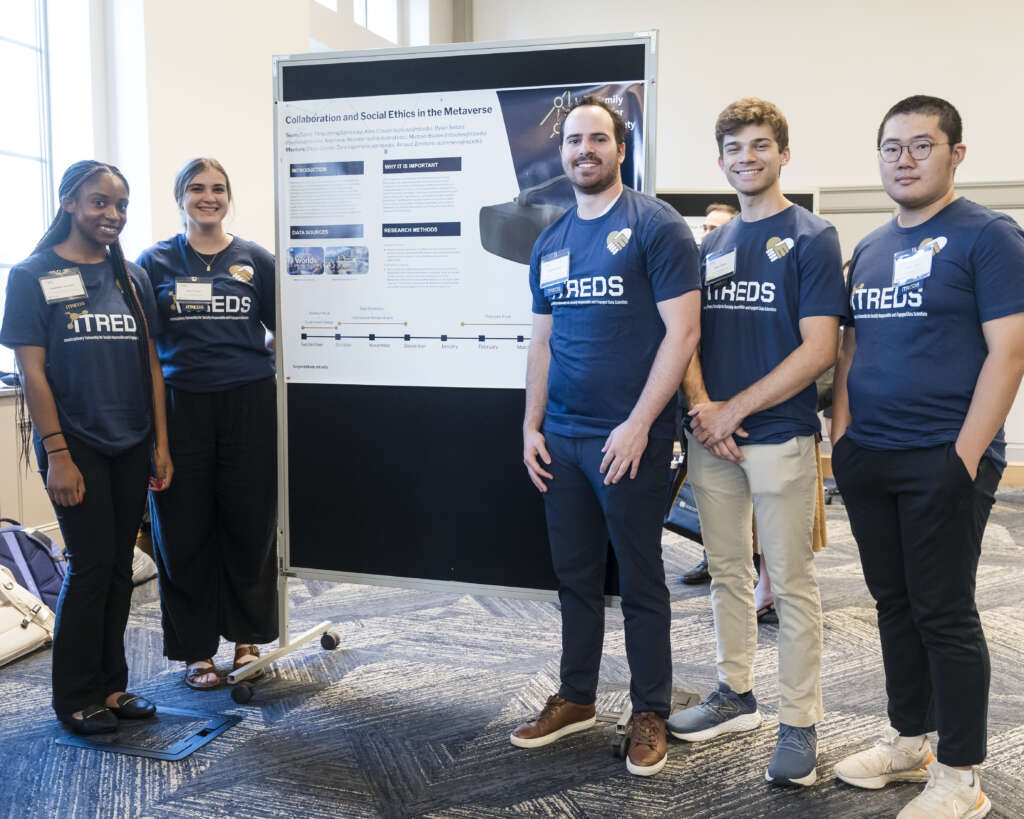
Collaboration and Social Ethics in the Metaverse
Team: Dylan Sellers, Kara Clouse, Sophonie Alcindor, Michael Bsales and Danny Tong
Advisors: Diego Gomez-Zara
Abstract: The Metaverse refers to a virtual shared space that results from the convergence of multiple digital platforms, supported by virtual reality (VR) and augmented reality (AR) devices. As a rapidly evolving technology, the Metaverse has the potential to transform the ways people communicate and work in the future by introducing immersive and interactive social experiences in the virtual world. However, due to the novelty of this technology, there are many significant, yet under-researched ethical implications associated with its use that require careful consideration. Through this research, the team will explore how the Metaverse provides novel ways of social collaboration and what challenges accompany this new technology.
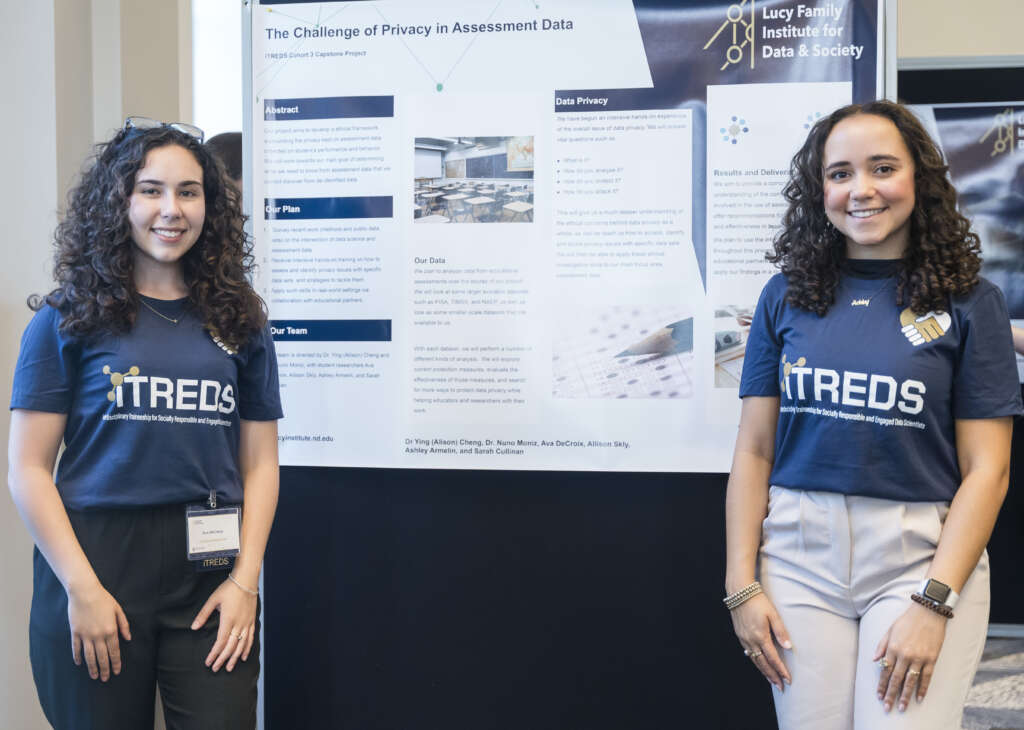
The Challenge of Privacy in Assessment Data
Team: Ava DeCroix, Allison Skly, Ashley Armelin, and Sarah Cullinan
Advisors: Prof. Ying (Alison) Cheng and Prof. Nuno Moniz
Abstract: The project aims to develop an ethical framework surrounding the privacy of assessment data collected on student performance and behavior. The team will analyze assessment data to discover insights that cannot be obtained from de-identified data.
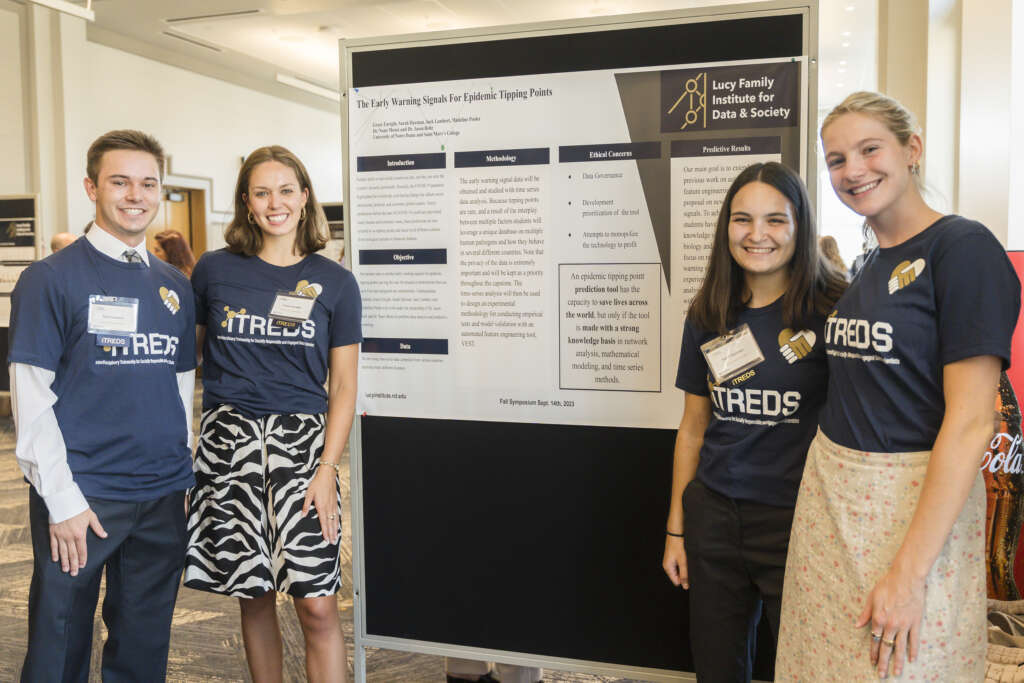
The Early Warning Signals For Epidemic Tipping Points
Team: Grace Enright, Sarah Harman, Jack Lambert and Madeline Pooler
Advisors: Prof. Nuno Moniz and Prof. Jason Rohr
Abstract: Sudden shifts in real-world systems are rare, yet they can alter the system’s dynamic profoundly. Recently, the COVID-19 pandemic highlighted the worldwide, ever-lasting change that affects social, educational, political, and economic global systems. Timely predictions before the start of COVID-19 could have prevented many human and economic losses, these predictions are also referred to as tipping points, and occur in all different systems, from biological systems to financial markets.
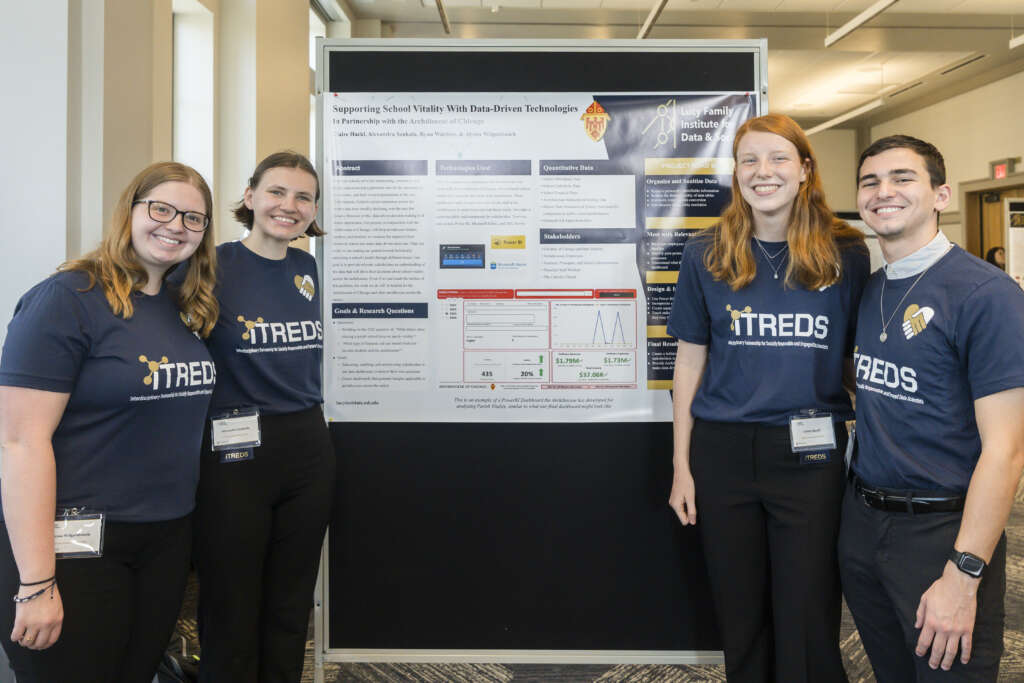
Supporting School Vitality With Data-Driven Technologies
Team: Claire Hackl, Alexandra Szukala, Ryan Wachter, & Alyssa Wilgenbusch
Advisors: Prof. Thomas Mustillo
Collaboration Partners: Sean Murdock, Emily Yeager, Betsy Bohlen, Deacon Gerry Keenan
Abstract: Parochial schools are known for providing quality education to the surrounding community, especially to the underserved, low-income, and hard-to-reach populations of the city. However, Catholic school attendance has been declining across the country for the past few decades. As a result, data-driven decision-making has become essential. This project, in collaboration with the Archdiocese of Chicago, aims to help archdiocese leaders, teachers, and families make data-driven decisions by visualizing the impact of their parochial school. The tools being developed will analyze a school’s health from different perspectives, providing relevant stakeholders with the necessary data to make informed decisions about school vitality across the archdiocese. Our efforts, though limited to addressing the surface of the problem, will prove to be of great assistance to the Archdiocese of Chicago and other archdioceses across the country.
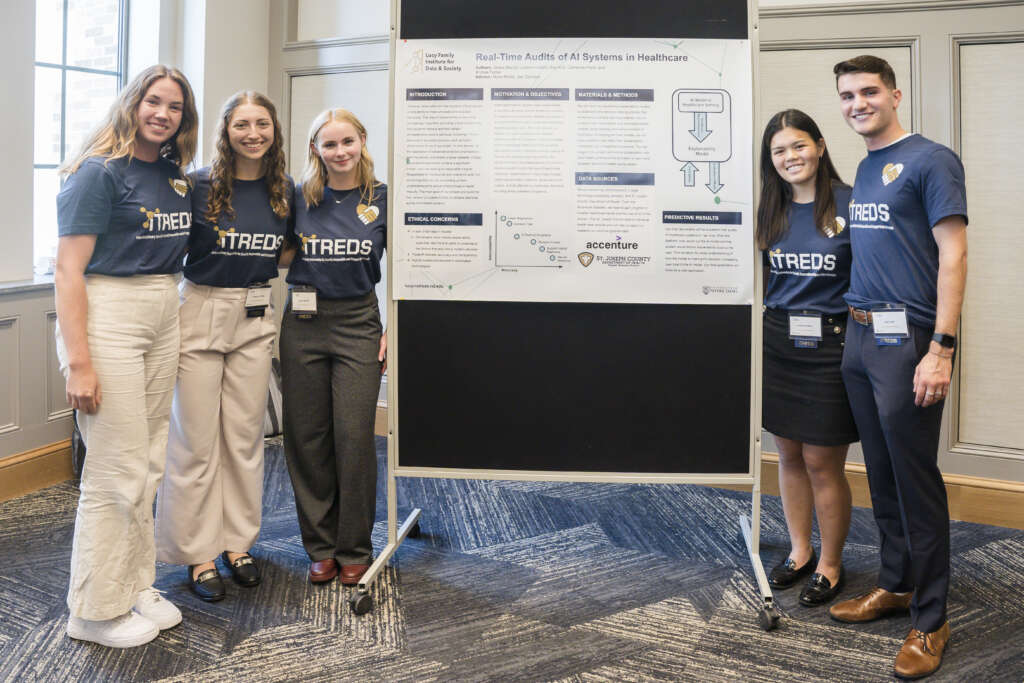
Real-Time Audits of AI Systems in Healthcare
Team: Grace Bezold, Justine Hulbert, Dan Krill, Catherine Pardi and Andrea Turner
Advisors: Prof. Nuno Moniz and Joe Germino
Abstract: Growing media attention has exposed critical issues in artificial intelligence (AI)’s ability to make unbiased and accurate decisions. The idea of explainability is becoming increasingly important, providing critical insights into how systems behave and how certain characteristics lead to particular outcomes. This is essential in sensitive domains, such as health, which is the focus of this project. In this domain, as the application of advanced analytics and machine learning grows, incomplete original datasets or false assumptions are known to have a significant impact, such as leading to inequitable insights. Responsible AI frameworks and coalitions exist, but screening tools do not, preventing us from understanding the actual effect of bias or health inequity. The main goal of this project is to build the first version of a platform that will enable real-time audits of AI-based systems.
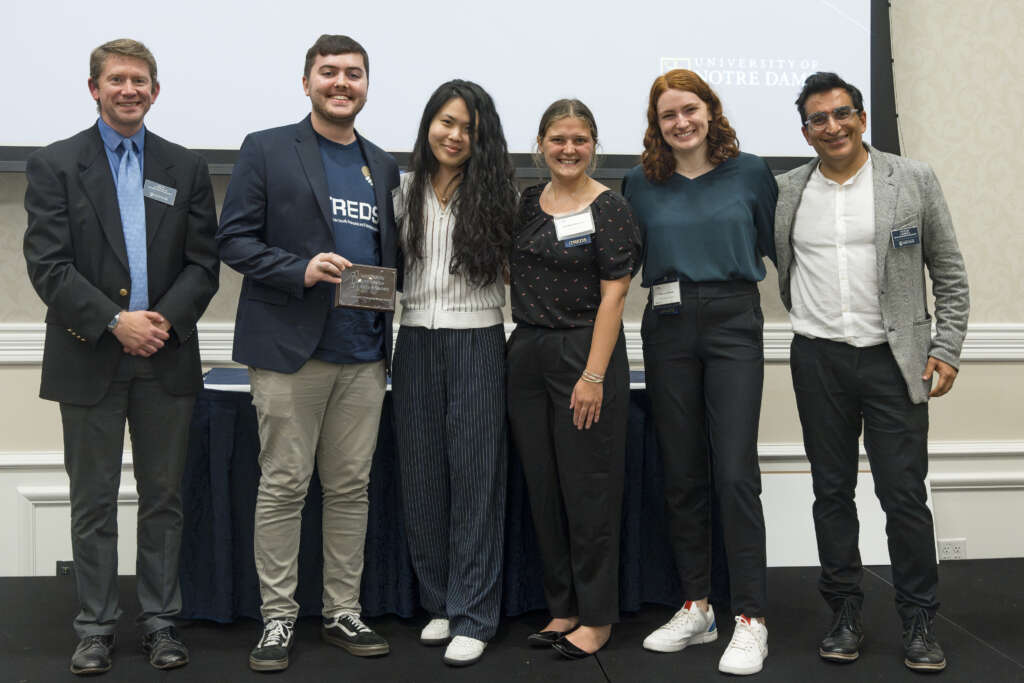
Health Inequities in Minorities: A Framework Based on EquIR
Team: Adam Toland, Catherine Schafer, Elizabeth Bourassa, and Joyce Fu
Advisors: Prof. Angélica García Martínez and Prof. Matthew L. Sisk
Collaboration Partner: Dr. Horacio Marquez-Gonzalez, Hospital Infantil de México Federico Gómez
Abstract: Healthcare access—and the provision thereof—differs across countries, cities, and neighborhoods. This project utilizes data from Mexico’s Hospital Infantil Federico Gómez (Mexico’s National Institute of Pediatrics) to track complications that patient-children develop over the course of their cancer treatment with the intention of establishing an example framework for comparison in other populations. Specifically, the project seeks to investigate any existing parallels between children in two regions with certain similar socio-economic conditions: Mexico’s Hospital Infantil Federico Gómez and South Bend. As part of this process, medical determinants such as one’s medical history, family life, financial support, social and emotional wellbeing, substance use, and access to treatment will be considered.
Award: Best Undergraduate Poster